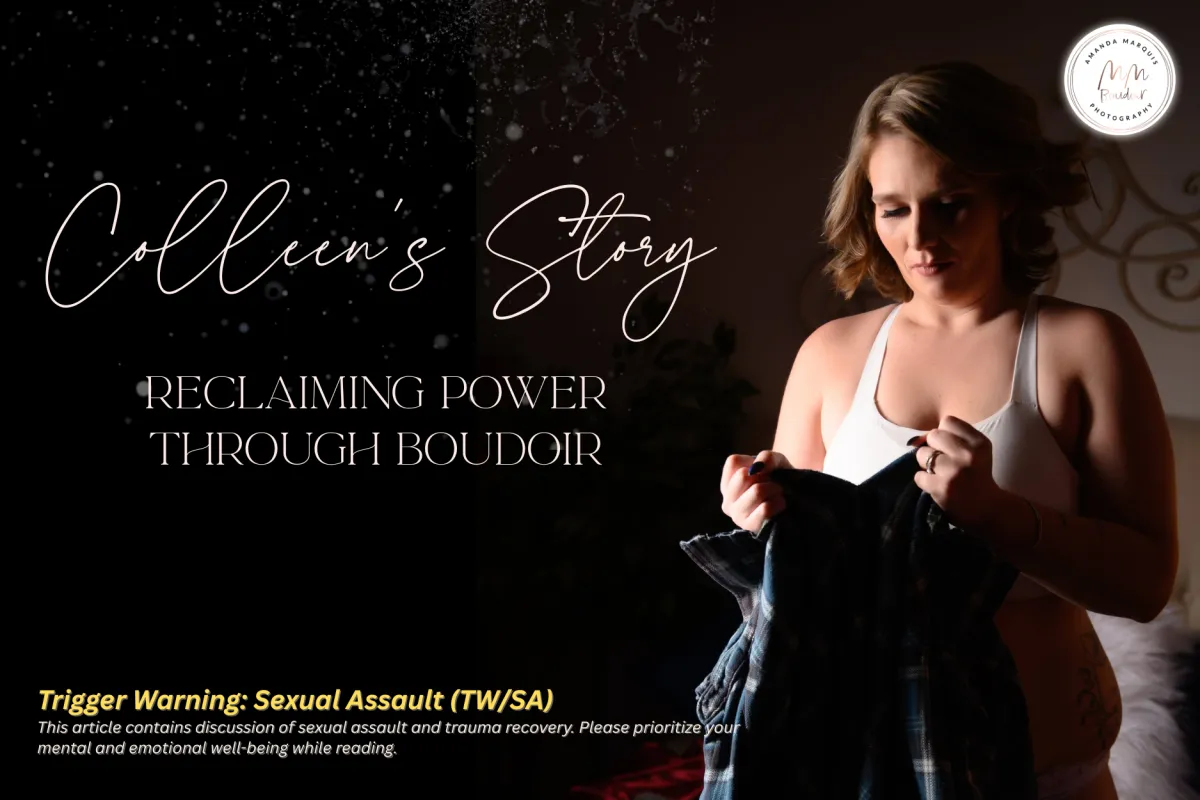
Colleen’s Story: Reclaiming Power Through Boudoir
This Story Matters
There are stories that change the way you see your work. Stories that settle into your bones and remind you exactly why you do what you do. Colleen’s story is one of those.
Boudoir photography is often talked about in terms of confidence, beauty, and self-love. And while all of that is true, there is another side that is quieter, deeper, and profoundly powerful. Boudoir can be a tool for healing. It can be a space where survivors reconnect with their bodies, rewrite narratives, and reclaim what was taken from them.
This is Colleen’s story. It is shared with care, consent, and purpose.
How Colleen Found Her Way to the Studio
Colleen was referred to me by her therapist.
She was not looking for glamour. She was not looking for validation. She was looking for healing.
Colleen is a survivor of sexual assault. She was date raped. In the aftermath, like so many survivors, her relationship with her body changed. Trust felt fractured. Safety felt distant. Her body no longer felt like her own.
Her therapist suggested a trauma-informed boudoir experience as part of her healing journey. A way to reconnect with herself on her own terms, in a controlled, supportive environment, where consent and agency are always the foundation.
That is how Colleen and I met.
The Wardrobe Consultation: Sharing the Why
Every session at the studio begins with a wardrobe consultation, but with Colleen, it became something more.
As we talked, she shared her story. She shared her pain, her anger, her fear, and her hope. She explained why she wanted to do this session, not to forget what happened, but to move forward with intention.
Then she told me something that stopped me in my tracks.
She still had the shirt she was wearing the night she was assaulted.
She had kept it all this time.
She did not say why. She did not need to. Survivors often hold onto objects tied to trauma, not because they want to relive it, but because letting go feels complicated. Tangible proof. Unresolved emotion. A moment frozen in time.
I gently told her that if she felt comfortable, she could bring the shirt with her to the session. There was no pressure. No expectation. Only an open invitation.
She said yes.
Creating a Safe, Trauma-Informed Space
Before Colleen ever stepped in front of the camera, we talked about boundaries, consent, and control.
She decided what she wore.
She decided what we photographed.
She decided when we stopped.
At any moment, she could change her mind.
This is what trauma-informed boudoir looks like. It is not about pushing comfort zones. It is about honoring them.
The studio was quiet that day. Intentional. Grounded. We moved slowly. Every pose was guided with care. Every step was collaborative.
When she was ready, she brought out the shirt.
Wearing the Shirt
Putting the shirt on was emotional.
You can see it in the images. The weight of memory. The tension in her shoulders. The way her body held itself differently. Her eyes told the story before words ever could.
This part of the session was not about beauty in the traditional sense. It was about truth.
She stood there wearing the shirt, confronting a version of herself that had been frozen in trauma for so long.
And then something shifted.

The Moment Everything Changed
Without rushing, without prompting, Colleen made a decision.
She ripped the shirt in half.
The sound was sharp. Final. Cathartic.
That moment was not staged. It was not planned. It was hers.
You can see the progression clearly through the images. The heaviness while wearing the shirt. The raw power in the act of tearing it apart. And finally, the release.
The last image in that series is different.
Her posture changes.
Her expression changes.
Her energy changes.
You can literally see her take herself back.
Reclaiming the Body After Trauma
For survivors of sexual assault, the body can feel like a battleground. Something that betrayed them. Something that no longer belongs to them.
Healing is not linear. It is layered. It is personal.
Boudoir does not heal trauma on its own. It is not a replacement for therapy. But when done ethically and intentionally, it can support healing by giving survivors agency, choice, and voice.
Colleen was not photographed for anyone else. These images were not created for validation or approval. They were created for her.
They are proof that her body is hers. Her story is hers. Her power is hers.
Life After the Session
Colleen’s session did not end when she left the studio.
Because of this experience, she has continued therapy. She has continued to grow. She has continued to find her voice and her strength.
This session became a turning point, not because it erased what happened, but because it helped her move forward with intention and ownership.
That is the power of being seen on your own terms.
Why Stories Like This Are Shared
Stories like Colleen’s are shared not to shock, but to remind survivors that they are not alone.
If you are reading this and recognizing yourself in any part of her journey, know this:
You are not broken.
You are not weak.
Your healing does not have to look like anyone else’s.
Boudoir is not about being sexy enough or confident enough. It is about meeting yourself where you are and honoring the version of you that shows up.

A Final Note on Consent and Privacy
Colleen chose to share her story. Her images are shared with explicit permission. Client confidentiality and autonomy are always respected at the studio.
Every survivor deserves control over their narrative.
You Are Allowed to Take Your Power Back
If you are considering a boudoir session as part of your healing journey, know that you will be met with compassion, patience, and respect.
You get to decide what healing looks like for you.
When you are ready, I am here.
Visit https://amandamarquisphotography.com/ to learn more about trauma-informed boudoir sessions and how to begin your own journey.


